
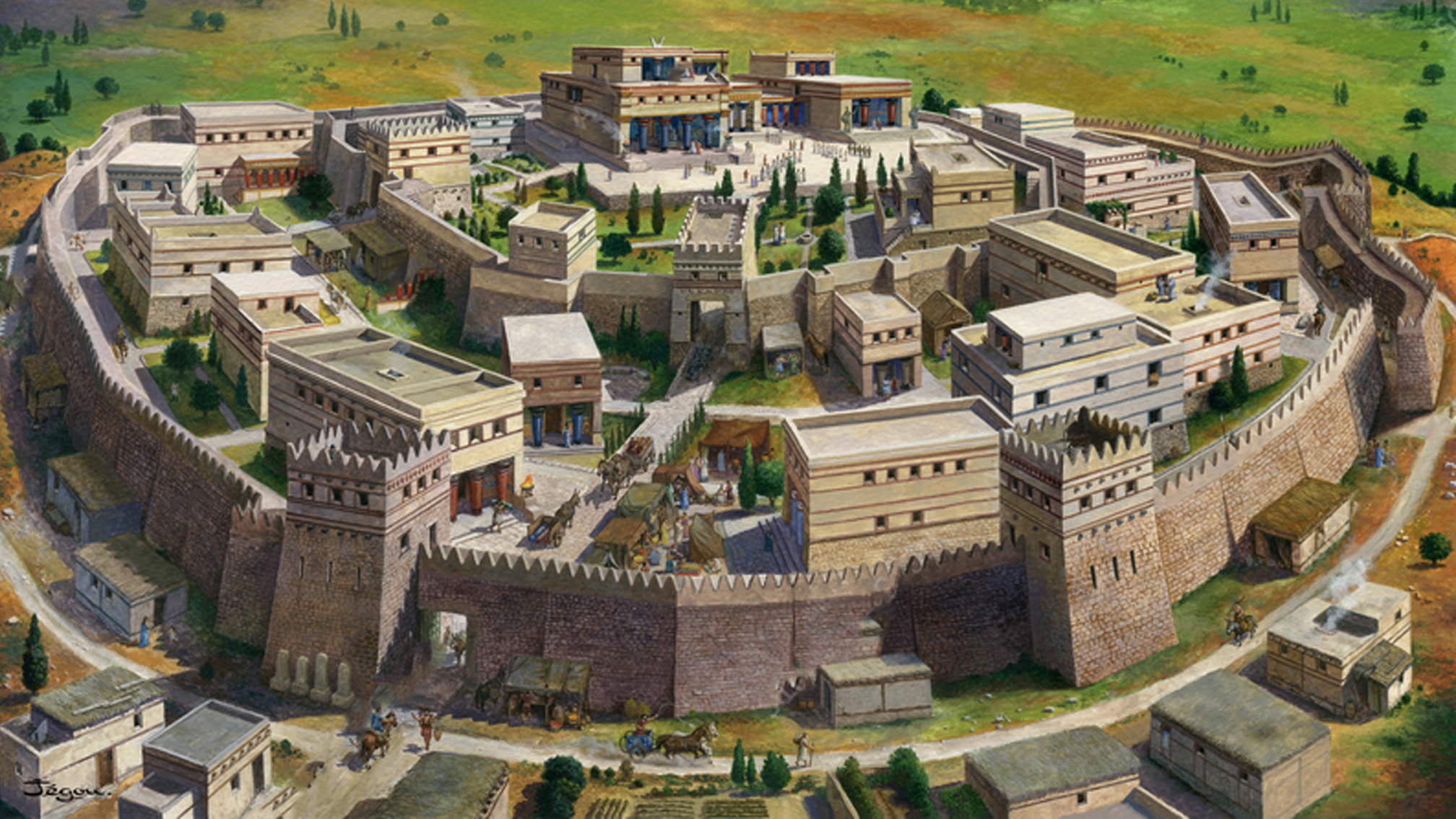
Illustration showing daily life in the ancient city of Troy, believed to be located in modern-day Turkey.
(Christian Jegou / Science Photo Library)
With Christopher Nolan’s film adaptation of Homer’s Odyssey slated for release on July 17, I figured it timely to revisit a feature of my teaching past. In olden days as a classroom teacher of ancient Greek history, I offered the following by way of introduction just before diving into a reading of the Iliad, Homer’s astonishing tale of the Trojan War. I wanted to set the mythological stage of how the volcanic rage of its protagonist, the great Achaean warrior Achilles, came to shape the course of that gruesome military contest. The following is a slightly revised version of that introduction.
Everyone knows— and many complain—that history books are filled with warfare. Have you ever taken a history course that didn’t require you to examine the causes, course, and consequences of some significant military contest? War is a constant of human history. What did Bob Dylan say when asked by Martin Keller in a 1983 interview with the Twin Cities Reader if he believed in peace? If memory serves, Dylan replied something like, “call the time it takes to reload peace.” You can decide for yourself whether that is more cynical than true. It does seem to be the case that every age and every corner of the globe has provided a battleground for the mass slaughter of human beings. One can hardly imagine how different the texture of the human experience would be without it. History books would certainly be different.
Edwin Starr scored a smash hit in 1970 with his song War. You’ve probably heard its memorable opening line, “War… what is it good for? Absolutely nothing.” Bruce Springsteen resurrected the song in 1986 and included it in his “Born In The USA” tour. Well, forgive me for taking on the Boss, but contrary to the sentiment expressed in the song’s lyrics and no matter how many times its refrain is repeated, war has brought countless benefits to mankind. For instance, war has served as the maternity ward of many nations. Exhibit A is our own Glorious Revolution against the British Empire. Military victory was also responsible for trouncing the tyrants of the 1930s—Hitler, Mussolini, Franco and Tito—and preserving democratic values over fascist rule. The experience of war has also been directly linked to the cultural progress of historically marginalized segments of society, in particular African Americans and women. Who can reasonably doubt that the peculiar demands of wartime loosened the traditional grip on our nation’s attitudes concerning racial segregation and gender roles? Finally, is there any debate about the role played by the Second World War in bringing to an end the Great Depression? Starr undoubtedly struck an emotional chord with his anti-war anthem that resonates to this day. And so long has humanity insists on taking its incessant bickering to the battlefield it probably always will.
Perhaps the oldest and most famous battle in all historical memory is the one told by the great poet of antiquity, Homer. His epic poem, the Iliad, recounts in vivid detail a portion of the horrific war fought between the Achaeans (Greeks) and the Trojans sometime around 1200 BC. Who hasn’t heard of its illustrious cast of characters: Agamemnon, King of Mycenae, beautiful Helen of Sparta (whose face launched a thousand ships), the crafty Odysseus, Troy’s tragic figures King Priam or Andromache, and the mighty warriors Diomedes, Big Ajax, and Hector? And what of the greatest champion of all—Achilles, the formidable offspring of both earth and heaven? Homer's Iliad charts the activities of over 800 specifically named individuals in such riveting detail that it remains as popular today as it was in the ancient world. A poem/song approximately 2,700 years old! Talk about a body of literature having legs! In order help your understanding and appreciation for this literary masterpiece, we need to provide a little mythological background information.
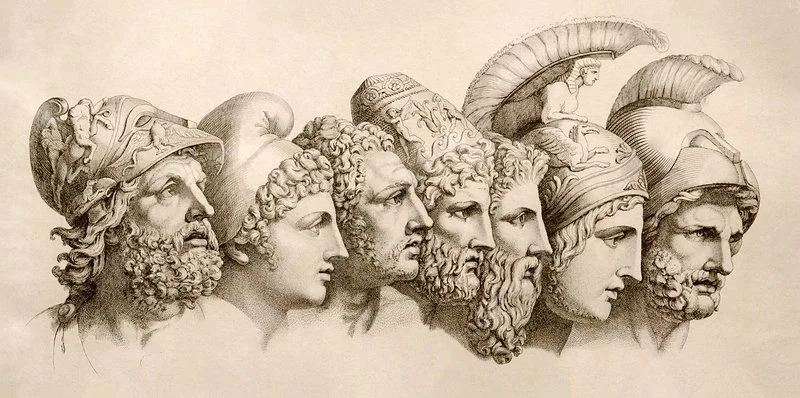
The seven heroes of Homer's Iliad, from left to right: Menelaus, Paris, Diomedes, Odysseus, Nestor, Achilles and Agamemnon.
From and engraving by Johann Heinrich Wilhelm c. 1796, in the British Museum. (David Parker / Science Photo Library)
Our story begins with Paris—no, not the French city—but a mild-mannered, somewhat timid, shepherd boy. The second of nineteen sons born to Troy’s King Priam and Queen Hecuba, he was doing what he normally did on any ordinary day, viz., wandering the surrounding hillside tending to the royal herd of sheep. (Actually, his father had exiled him to this post in a futile attempt to frustrate destiny.) But this was to be no ordinary day. It was going to be a fateful day— a ba-a-a-a-a-a-d day. In one split second, the calm routine of his morning was shattered by an intrusion from the heavens. All of the sudden it got crowded around him. Hermes, the messenger god of the Olympians, arrived and he hadn’t come alone or empty-handed. He brought along a golden apple and three powerful goddesses: Hera (the sister/queen of Zeus) and two of their daughters, Athena and Aphrodite. He’d also brought along a challenge.
Just prior to this hilltop visitation, a wedding ceremony had gone terribly awry. King Peleus of Phthia and his lovely bride, the sea nymph, Thetis, (Achilles’ future parents) were enjoying their nuptials far away on the Thessalian site of Mt. Pelion when the mother of all wedding crashers made her entrance. For reasons that should be obvious, a wedding invitation had never been sent to Eris, the goddess of strife. No matter, she did what came naturally to her, barging in uninvited and unannounced. And then she commenced to do what her nature compelled her to do—instigate trouble. She thought it would liven things up a bit to throw onto the banquet table a golden apple with the words “for the fairest” inscribed on it. Needless to say, Hera, Athena, and Aphrodite each assumed the gift belonged to her. Who had the wisdom or authority—or stupidity—to select the most deserving? Zeus wanted no part of it. He chose (or was it Fate’s decree?) to pass the job off to our unsuspecting shepherd.
What was Paris to do? He had never been a judge in a beauty contest before. Could he decline the assignment? Who can deny Zeus? Reluctantly accepting his lot, he made a first—and most curious—request of each of the contestants. Paris asked that each disrobe and present herself to him naked. Hera was the first to be inspected. She sought to secure his vote with a promise to make him absolute ruler over all of Asia and its vast riches. Athena went next. She offered to give him an extreme makeover, transforming Paris into the most handsome and intelligent man in the world. She added as a bonus her guarantee that he would experience only success in military affairs. Batting third in the lineup was the brash bombshell herself—mighty Aphrodite. She knew she possessed an unfair advantage over her competitors; she was, after all, the goddess of love. Like all winners, Aphrodite played to her strength. She drew close to Paris, uncomfortably so, causing the royal shepherd boy to blush redder than a tomato. The bribe she cooed along with her naked proximity was the love of the earth’s most beautiful woman. She was, of course, referring to Helen of Sparta, purposely neglecting to mention the fact that Helen was already married to Menelaus, the king of Sparta.
Aphrodite got the fruit and Hera and Athena got mad, storming off to plot their revenge. The first chapter in their Big Book of Revenge would be the total obliteration of Paris’ hometown, Troy. When a diplomatic mission brought Paris’ ships to the kingdom of Sparta, the Trojan prince was utterly gobsmacked with Helen’s beauty. Just like everyone who laid eyes on her. Whether or not Helen went freely with Paris or was forced against her will depends on which version of the story one prefers. Freely or not, King Menelaus was furious, immediately enlisting the support of his brother, King Agamemnon of Mycenae, to retrieve her. Agamemnon mustered a Greek military force of over 100,000 warriors from 29 separate regions to be ferried to Troy by an armada of 1,186 ships. The awesome Achaean (Greek) army was to set sail from the port city of Aulis. Delayed by goddess Artemis’ withholding of favorable winds, King Agamemnon sacrificed his eldest daughter, Iphigenia, as an act of atonement. He would pay dearly for this when he returned home after the war to face the music of his wife, Clytemnestra.
And, thus, the Trojan War began.
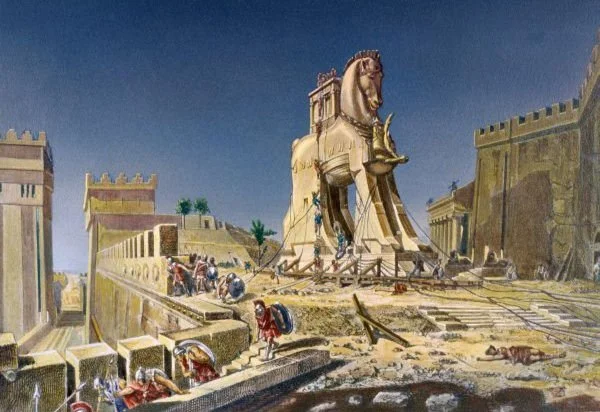
The Trojan Horse Tetraktyas (CC BY-SA)