
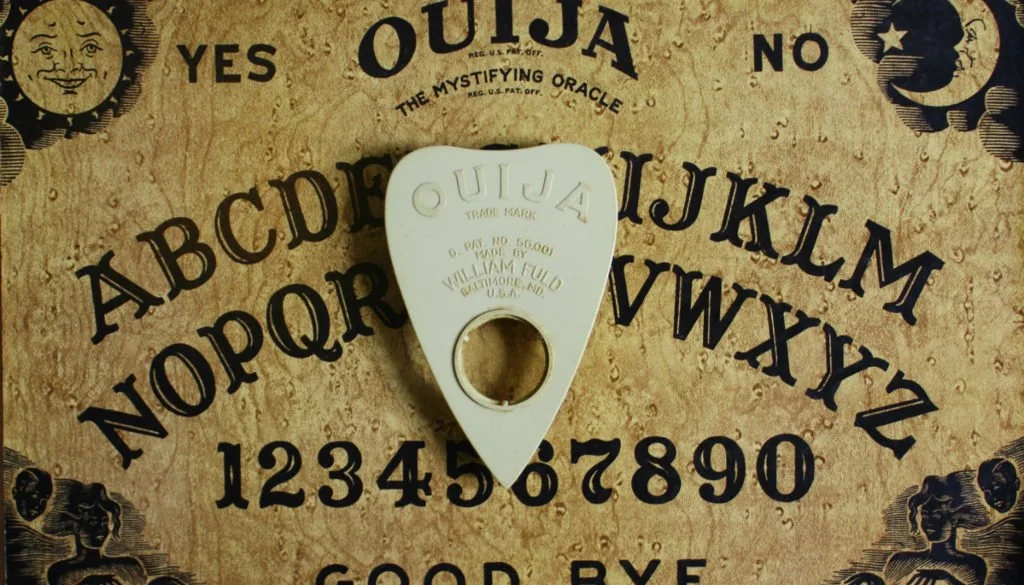
About thirteen minutes into what is arguably the scariest movie ever made—The Exorcist—we eavesdrop on some light-hearted banter between a mother and her daughter. Chris MacNeil (Ellen Burstyn) is in the basement playroom of her Georgetown home with 12-year-old Regan (Linda Blair). As Regan approaches the ping-pong table located in the center of the room, mom notices and picks up a Ouija board from a pile of things and asks her daughter what it is. Regan explains that she found it in a closet and has been using it alone. “Wait a minute, you need two to play,” notes Chris, as she suggests that they both give it a whirl. Placing it on the ping-pong table, Regan barely touches the planchette—the heart-shaped plastic pointer—when it jerks away, seemingly on its own. Asking for a mother-daughter game, Regan tells her that “Captain Howdy said no.” “Who’s that?” asks Mom, and Regan innocently explains, “You know, I make the questions and he does the answers…he’s nice.” She gives her mother a playful demonstration: “Captain Howdy, do you think my mom’s pretty?” The board goes silent—no response. Regan scolds it, “Captain Howdy, that isn’t very nice.” End of scene. But hardly the end of Captain Howdy.
Sales of the popular board game are said to have plummeted in the aftermath of the film’s 1973 release. Perhaps it wasn’t such a fun game after all.
Where and how did the Ouija board begin?
Its origins require a little bit of historical context. I promise, just a little.
Remember how ‘Beatlemania’ skipped first across the pond and then circled the globe in 1964? Well, in the mid-to-late 19th century, another spectacular sensation showed how contagious it was, spreading from its birthplace in the tiny rural hamlet of Hydesville in upstate New York into the sophisticated courts and perfumed salons of Queen Victoria and Tsar Alexander II.
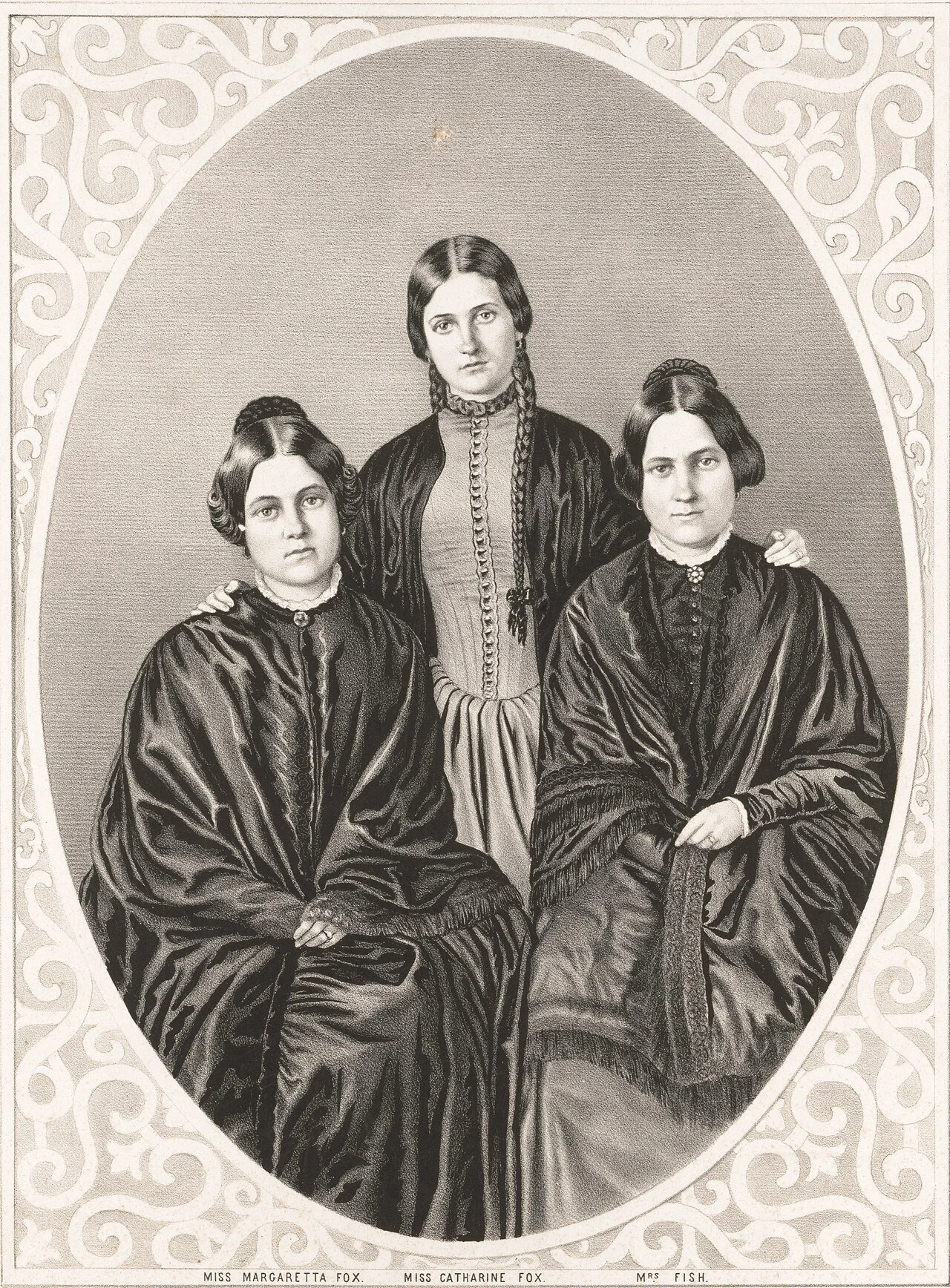
Maggie, Kate, and Leah Fox.
On March 31, 1848, two young sisters—Maggie, 14, and Kate Fox, 11—announced that they were in communication with “spirits” from the beyond through “rappings” and “knocks” emanating from walls and furniture. Given the religious fervor of the Second Great Awakening—a widespread Christian revival that swept the nation in the late 18th and early 19th centuries—their experiences quickly ignited a national craze for Spiritualism. Mediums, table-turning, table-rappers, and séances soon became common practice across North America and the UK, rapidly spreading to both the unschooled and the learned throughout France, Spain, Latin America, and Russia.
Everybody caught the bug. The 1850s underwent a wave of “Foxamania” as Leah Fox Fish, the eldest sister, assumed managerial duties. She took the show on the road, relocating the family from rural obscurity straight to the Big Apple. They hit the big time, hosting public séances and high-profile paranormal demonstrations. The sorrows and acute grief that attended the slaughter of the Civil War only expanded their market.
Not everyone, however, was as much an enthusiast as Mary Todd Lincoln, Sir Arthur Conan Doyle, Queen Victoria, or Tsar Alexander II. Dmitri Mendelev, the reknowned Russian chemist, found it all a bunch of nonsense, a perversity of science and rationality that led him to launch a crusade against it in 1875. Following his lead, but for different reasons, Count Leo Tolstoy expressed utter contempt for the fashion in a novel he was writing at the time, Anna Karenina. You can see for yourself in Part One, Chapter 14, and more thoroughly in Part Seven, chapters 21 and 22.
And then there were those of a more entrepreneurial aspect who saw only dollar signs floating across their eyes. There was good money to be made in all this madness. American newspapers in 1886 had reported the existence of a board game involving letters and numbers being played in Spiritualist camps in Ohio. A group of investors looked into it and decided the time was ripe for cashing in on the craze. The Baltimore Kennard Novelty Company was born.
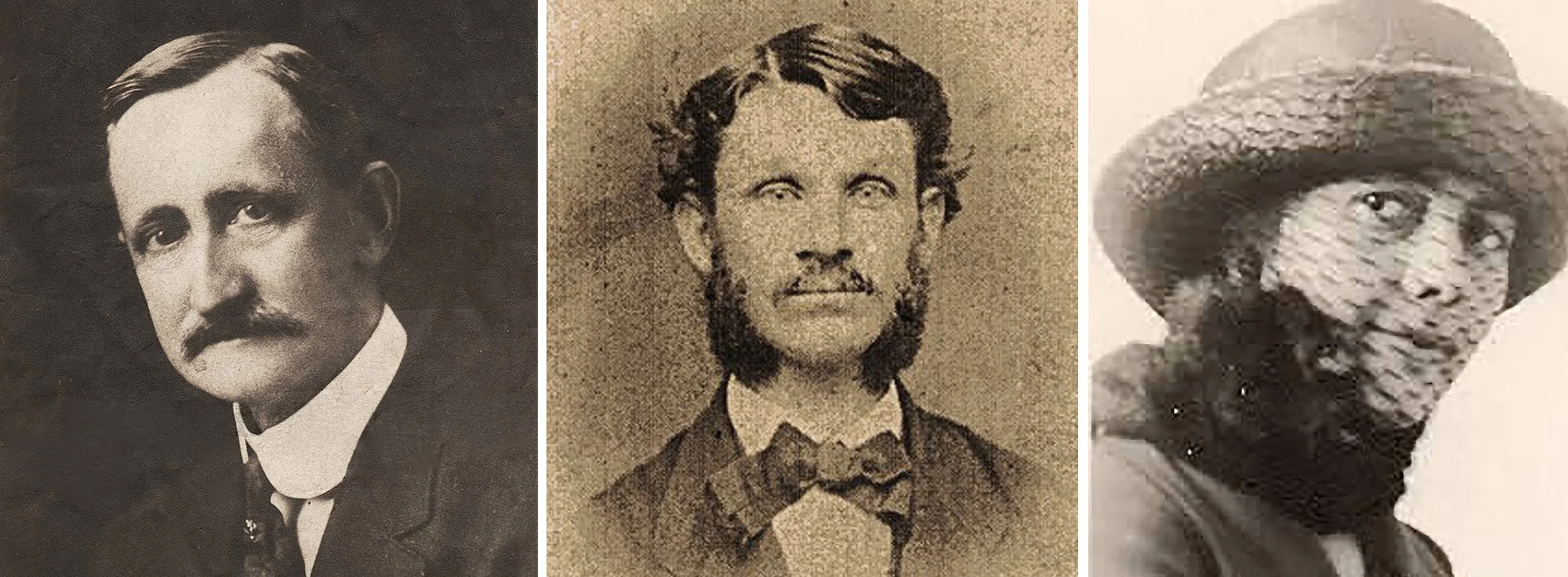
Charles Wesley Kennard, Elijah Bond, and Helen Peters.
Charles W. Kennard and attorney Elijah Bond were principal investors eager to get into the action. Their Baltimore factory produced the first Ouija board, thanks in part to Bond’s sister-in-law, Helen Peters, (herself a ‘strong medium’) who messaged the name “Ouija” from the board itself—being told by the agency of the planchette the word meant ‘good luck.’ The board named itself.
The company had filed a patent request on July 30, 1890. The patent officer gave his conditional approval, writing that “action on the merits is suspended until the device is proven by a working model to be operative, as volunteered by the applicant.”
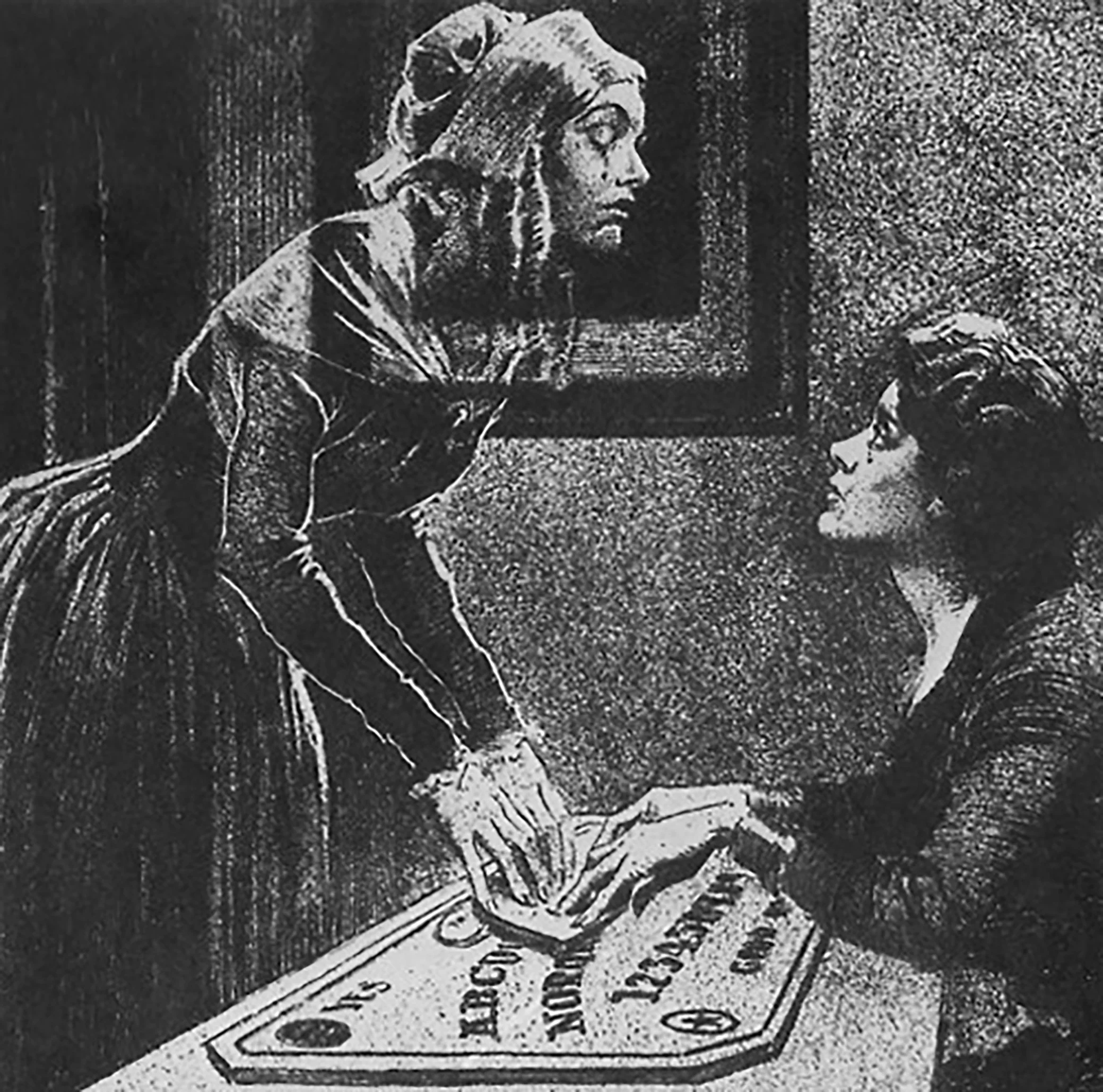
So, Elijah Bond brought along Peters for a visit to the patent office in Washington, D. C. on February 10, 1891. The chief patent officer requested a demonstration. He tested them to have their “talking” board spell out his full name—something they did not know. Instantly, the planchette faithfully spelled out his name. A ghostly-white-faced and visibly shaken official awarded Bond the patent for his creation: US Patent No. 446,054
The first patent describes the device but offers no explanation as to how it works. That ambiguity (I’m thinking here of Elizabeth Holmes) was a deliberate piece of their marketing strategy. The mysterious element enhanced the lure. And it worked. By 1892, the Kennard Novelty Company was busting at the seams—it went from one to two Baltimore factories, two in New York, two in Chicago, and one in London.
Success led to bad blood within the organization, resulting in a change in management. Both Kennard and Bond were given the boot. William Fuld was now running the show. (Curiously, Fuld died in 1927 after a freak fall from the roof of his new factory; a factory he claimed the Ouija board had directed him to build. Spooky.)
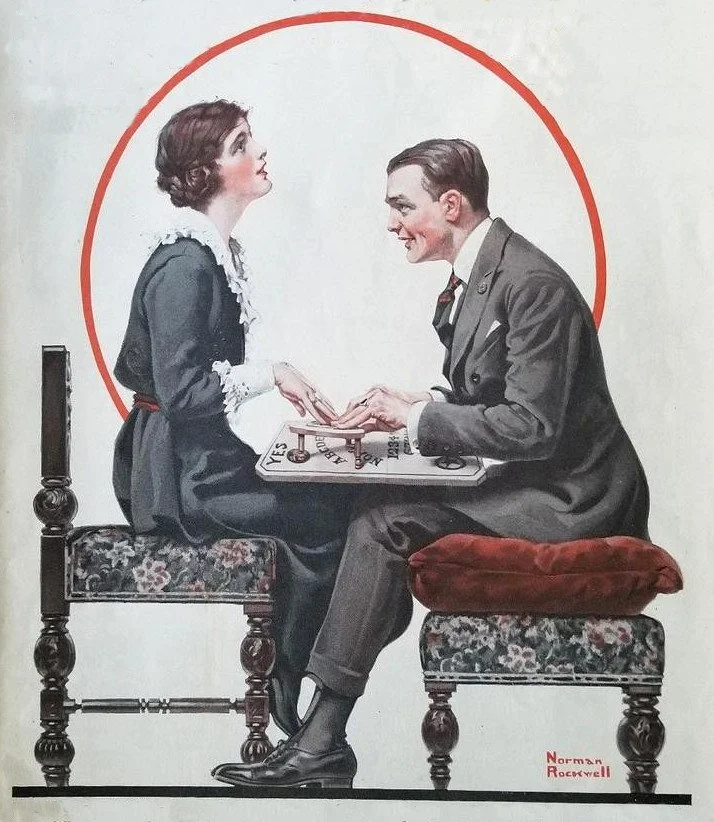
The game grew extremely popular in the 1910s-1920s. Norman Rockwell even painted a picture of a man and woman playing with a Ouija board for the May 1, 1920, cover of the Saturday Evening Post.
But was its popularity a good thing?
National wire services began to report strange goings on. Some wanna-be crime solvers were turning to their game boards for clues in the mysterious murder of a New York City gambler, Joseph Browne Elwell. In 1921, the New York Times reported that a Chicago woman was sent to a psychiatric facility after developing ‘religious hallucinations’ brought on by a Ouija board. She described how it all began: “We started by getting sermons from the beyond. We have hundreds of these sermons that we typewrote and preserved. They are hidden away from prying eyes. These sermons grew more and more beautiful. All of them came from the Ouija board…I myself was doubtful. But after the Ouija board had been talking to us for days, we just had to believe.”
Such paranormal activities were being reported on a regular basis. A Buffalo woman joined a murder party at the urging of the board. A New Jersey gas attendant enlisted in the Army at the direction of his Ouija board. Poets claimed that their poems were the work of spirits of great authors channeling through them—such as Twain, W. H. Auden, or Gertrude Stein.
Another indication of the reach of the board’s popularity was provided by G. K. Chesterton, a prolific English journalist and influential Christian apologist. His 1936 autobiography contains a chapter titled “How to be a Lunatic,” in which he describes how his early years of “doubts, morbidities, and temptations” led him into a brief exploration of Spiritualism. He writes how he and his brother Cecil “used to play with the planchette, or what the Americans call the ouija board…I would not rule out the suggestion of some that we were playing with fire; or even with hell fire.” In a less serious vein, Chesterton also recounts that his “dabbling” resulted in several instances of comedy, given the ridiculous responses the board provided to a few of their inquiries.
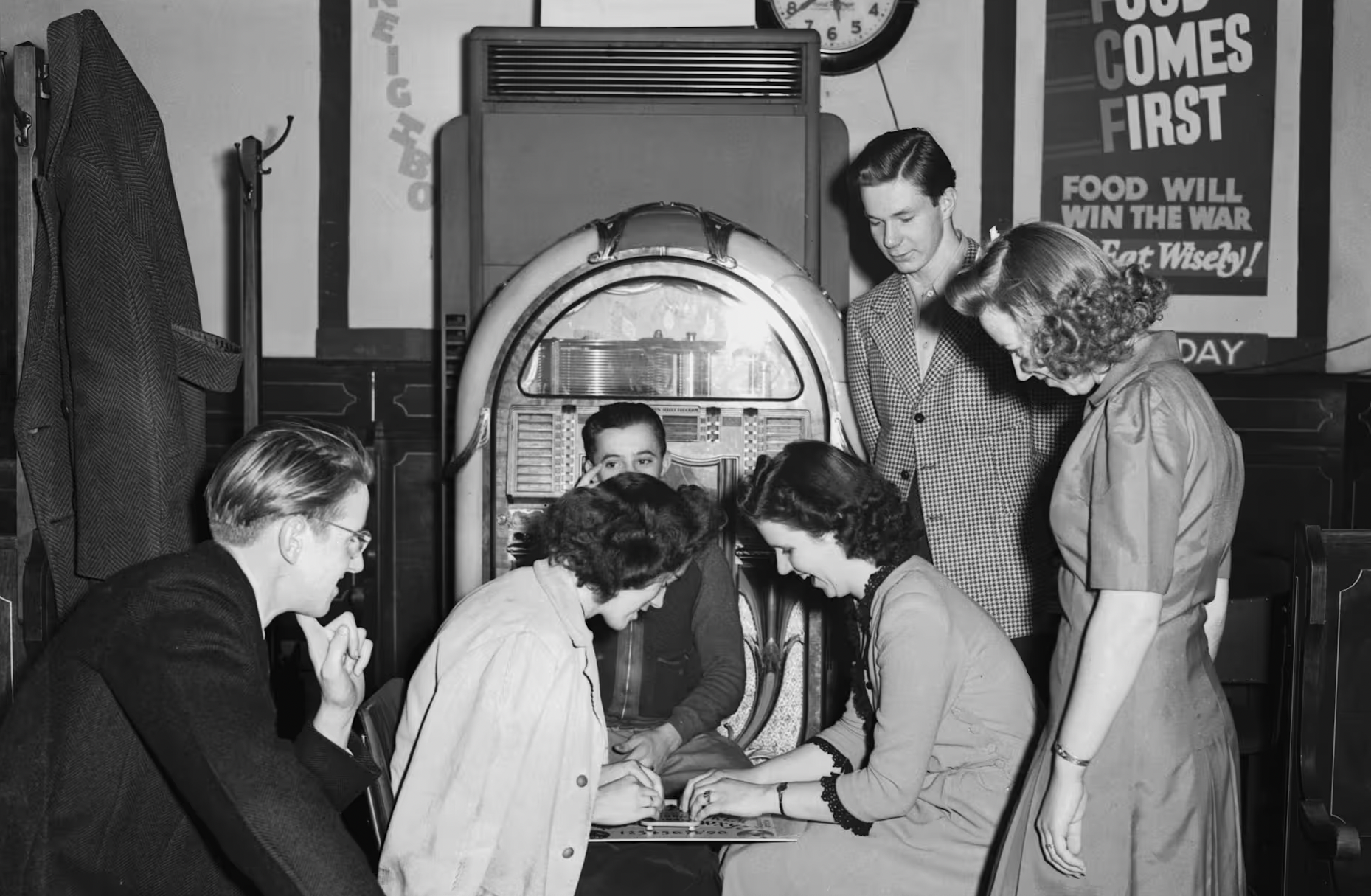
Sales of the game board showed little indication of decline. In 1944, one New York department store reported selling 50,000 Ouija boards over a five-month period.
On February 24, 1966, Parker Brothers purchased the game for $1 million. It quickly sold over two million boards, outselling their top family game, Monopoly. They relocated their manufacturing facility out of Baltimore to Salem, Massachusetts. No kidding.
Hasbro bought out Parker Brothers in 1991 and began releasing a new line of Ouija game boards. In 1998, the company released a plastic glow-in-the-dark version featuring a luminous board and planchette.
The item’s enduring fascination encountered continuing backlash from those convinced of its inherent ‘demonic’ properties. Members of Pastor Jack Brock’s Christ Community Church in Alamogordo, New Mexico, consigned it to the flames in a massive bonfire on December 30, 2001, along with other ‘occult’ items such as Harry Potter books, J.R.R. Tolkien novels, Stephen King horror books, AC/DC records, and various works of William Shakespeare.
In 2011, Christian evangelist Pat Robertson, host of the 700 Club TV show, declared that demons could reach people through the board.
That didn’t stop Hasbro from releasing in 2024 the Exorcist Collector’s Edition of the Ouija board as part of its Halloween lineup. It came with glow-in-the-dark pea-soup green reveals and demonic quotations. How nice.
What does one make of a mechanism that requires no batteries, just belief? What does a game board that purports to provide messages from the beyond tell us about us? Elijah Bond and Charles Kennard had a pretty good idea.